You can't optimize what you can't see - and an aircraft turnaround has too many moving parts to watch.
A leading European airport authority needed a structured view of every turnaround on its apron - we built it from the CCTV they already had.
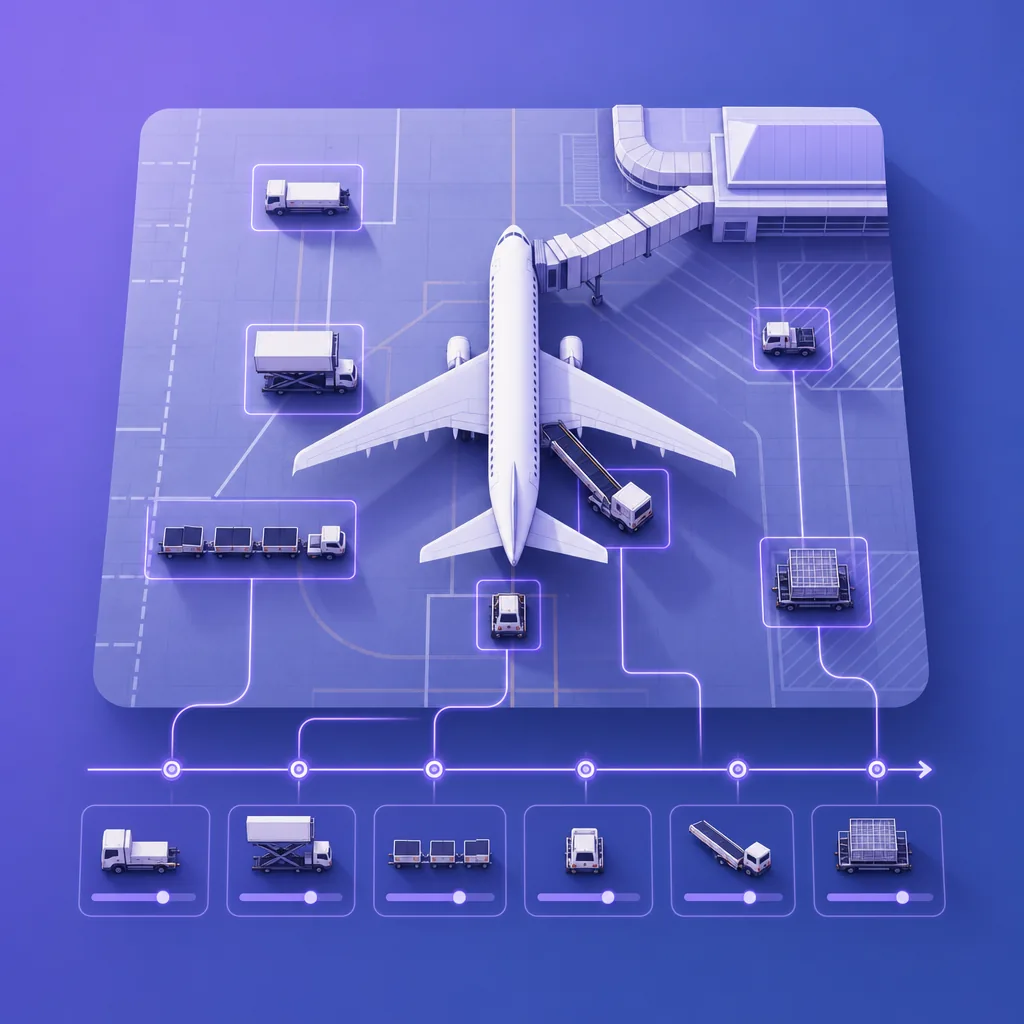
Aircraft turnaround is one of the most operationally dense windows in commercial aviation. From the moment a plane parks to the moment it pushes back, fuel trucks, catering, baggage loaders, ground crew, pilots, and cleaning teams interleave under tight timing constraints. Yet operational visibility into that choreography was patchy. Vehicle movements weren't consistently tracked. Staff assignments lacked real-time validation. Bottlenecks were known anecdotally but not measured systematically. Without the data, resource planning ran on assumption and seasonality was invisible until after the fact. The question: could we use existing CCTV feeds - the cameras already on the apron - to produce structured, machine-readable turnaround timelines for every aircraft?
- 01
Fine-tune the detector for the actual operating environment.
Off-the-shelf object detection doesn't know fuel trucks from catering trucks from baggage loaders. We fine-tuned a detector on the airport's own footage, recognizing every ground-handling asset and action: vehicles, equipment, passenger flows, pilot walk-arounds. The judgment call: domain-specific training pays for itself the first time a downstream metric depends on it.
- 02
Track identity, not just presence.
Detection tells you what is in the frame. Reconstruction requires knowing which fuel truck - across minutes, across handoffs. We built multi-object tracking that maintains consistent identity through the chaos of an apron in motion, so the same vehicle's arrival, dwell, and departure all attach to one entity.
- 03
Assemble events into a timeline, not a feed.
A stream of detection events is data exhaust. A structured turnaround timeline - every choreographed step, sequenced and timestamped - is decision-grade. We built the timeline engine that converted the former into the latter, producing one structured record per aircraft per turnaround.
Operations leadership now sees every ground-handling step, end-to-end, for every flight. Workforce and vehicle planning gained real operational margin - adjustable in response to measured patterns rather than seasonal habit. Bottlenecks across the turnaround pipeline became identifiable, then addressable. Historical timelines surfaced patterns and seasonality that informed multi-quarter resource decisions. The unlock: turnaround optimization stopped being a strategic intuition and became an operational metric.
“Computer vision earns its keep when it turns existing infrastructure into structured data. The cameras were already there - the timeline is what was missing.
Sitting on CCTV, telemetry, or sensor data that's logging everything and informing nothing? We help operations leaders turn raw feeds into operational timelines you can plan against.
Let's talk