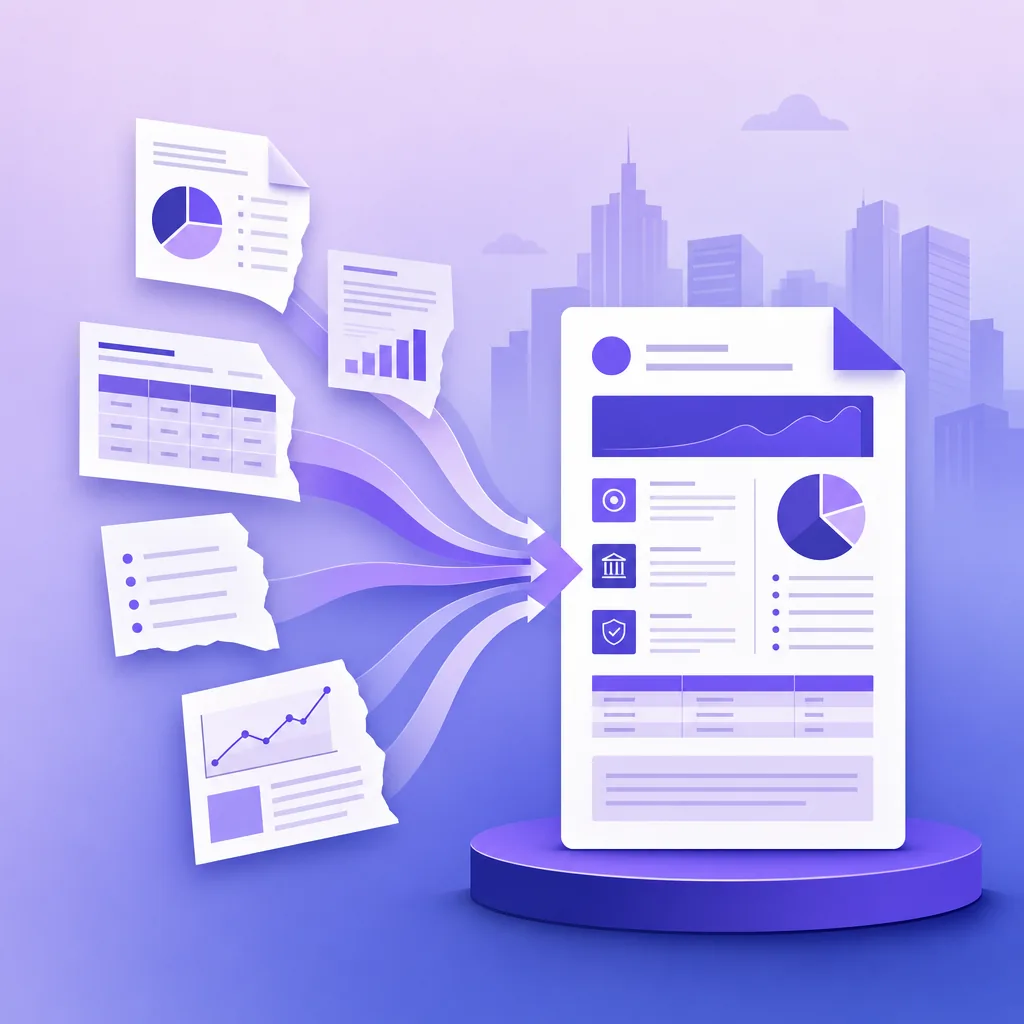
Two days of work hidden inside every annual statement.
A global tier-1 corporate & investment bank was paying senior analyst time to do data entry - we built the pipeline that gave them the hour they actually needed.

Every corporate client the bank covers files financial statements multiple times a year. Each statement gets parsed by an analyst, mapped against the bank's internal indicator taxonomy, validated, and loaded into the systems that drive credit decisions. Two days per statement, repeated across thousands of clients, multiple times a year. The cost wasn't just time - it was variance: different analysts mapping the same indicators slightly differently, in different languages, with different defaults. The question: could a structured AI pipeline replace the manual parse without sacrificing the rule-grade validation that the credit function depends on?
- 01
Decompose the workflow into five auditable steps.
Clean, detect, extract, match, check. Each stage does one thing, and each stage produces output a human can verify. The judgment call: we resisted the temptation to wrap the whole pipeline in one large model. End-to-end opacity is the enemy of credit-grade workflows - five auditable steps beat one inscrutable one every time.
- 02
Build for ten languages from day one.
The bank's portfolio spans Europe, Asia-Pacific, and Latin America. We deployed the pipeline in EN, ES, DE, PT, CZ, RO, HU, JA, KO, and ZH simultaneously, rather than building for English first and translating later. International coverage was the design constraint, not the afterthought.
- 03
Validate against the bank's own logic.
Mapping extracted indicators to the internal taxonomy is half the job. The other half is checking the math - Assets equals Liabilities plus Equity, and dozens of similar invariants. We embedded the bank's business rules into the pipeline itself, so the output is pre-validated before it reaches an analyst.
Two days of processing per statement compressed into roughly one hour. The same client's recurring statements now flow through the pipeline multiple times a year with minimal manual touch. Data reliability improved because rule-based validation runs every time, on every statement - the kind of consistency that's hard to maintain across hundreds of analysts. International coverage now matches the bank's actual portfolio footprint. The unlock: senior analyst time redirected from data entry toward analysis.
“When the workflow is regulated, build for auditability over elegance. Five steps you can verify will beat one model you can't - every single audit cycle.
Watching senior analyst time disappear into recurring document parsing? We help financial-services teams turn statement processing from a two-day task into a one-hour pipeline.
Let's talk